
Is our Universe stuffed with Black Holes?
Cosmic processes responsible for the formation of black holes in the early universe are loud gravitational-wave sources. If these early black holes still fill the cosmos, gravitational-wave observations will tell.
An article by Guillem Domenech
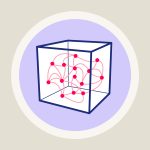
Cosmology is entering an exciting period. Several long-standing puzzles remain unsolved, while recent observations hint that our current picture is incomplete. Several observations may point to new phenomena in the very early universe—everything, including dark matter, is thought to have originated then. Unfortunately, despite promising proposals, direct searches for previously unknown particles have so far come up empty-handed. This is why some researchers are wondering: what if most of the matter in the Universe were made not of particles, but of black holes formed fractions of a second after the Big Bang?
Here is a crucial point: cosmology depends only on the collective behaviour of matter. In other words, the Universe does not care if dark matter is made of new microscopic particles or compact objects, as long as they are much, much smaller than, say, a galaxy—something not so difficult to achieve, as you can imagine. Furthermore, black holes satisfy the three essential requirements of a dark matter candidate:
- They are dark.
- They are cold/heavy.
- They interact only gravitationally.
This is, of course, speculation. But, at the moment, so is any dark matter model.
The idea that black holes are the dark matter–which, recall, makes up 27% of the total energy budget of the universe–may sound preposterous. Shouldn’t we have noticed? Not necessarily, but we will. And to understand how, we have to take a trip back to the time of the Big Bang. In three stops, you will get to know:
- The possible role of black holes in the Universe,
- Black hole formation in the primordial universe, and
- The associated gravitational wave (GW) background.
At our final destination, we will see that the formation of black holes in the primordial universe has a loud GW counterpart, even if primordial black holes account only for a small fraction of dark matter.
The role of Black Holes in the Universe
We know black holes exist in our Universe. Since 2015, the LIGO/VIRGO/KAGRA collaboration has detected hundreds of GW events, the vast majority from binary black hole mergers (see also the O3 observation run of the LIGO collaboration). The Event Horizon Telescope has also observed the shadows of the supermassive black holes at the centres of our Milky Way (called Sagittarius A*) and our neighbouring galaxy (Messier 87).
The general expectation is that both observations can be explained by astrophysical (a.k.a. stellar) black holes, namely those formed by the collapse of a star. But, as of now, we cannot exclude other origins for the observed black holes; quite the opposite. For example, in the GW merger events catalogue, there are several black holes in a mass range—around 50 to 150 solar masses—that are difficult to explain from astrophysics alone, unless they are born from previous mergers. On the other hand, with our current knowledge, it is hard to explain the growth of supermassive black holes at the centre of galaxies unless there were initial heavy seeds. Early seeds might also explain the early galaxies observed by the James Webb Space Telescope (JWST).
However, if black holes play an important role in the universe, they cannot come from the collapse of a star. They must have formed much earlier, around the time of the Big Bang. This possibility was proposed by Stephen Hawking in 1971 and further developed by him and his PhD student, Bernard Carr, in 1974. They called this type of black hole a Primordial Black Hole, or PBH for short. Note that PBHs are “normal” black holes, but differ from stellar black holes in their origin. 50 years later, we are testing this idea with GWs.
Black holes as dark matter
It may seem obvious that we would have noticed such PBHs already if they accounted for all dark matter. Surprisingly, that is not always the case.
First, for PBHs to be the dark matter, they must be very light, with approximately the mass of a small asteroid, around 1015 to 1018 kilograms. If they were lighter, they would have evaporated by today. If they were heavier, we would have seen distortions of nearby stars due to gravitational lensing by flying-by PBHs. Or maybe we have already seen them; there are recent claims of several lensing events by compact objects of lunar mass. For comparison, 243 Ida, an asteroid from the main belt between Mars and Jupiter, has a mass of around 4⨉1016 kilograms and a radius of 16 kilometres. Instead, a PBH with Ida’s mass would have a radius of 60 picometers–this is the size of the Hydrogen atom! Another example: The moon has a radius of 1700 kilometres, but a PBH with the same mass has a radius of a millimetre. The size differences are abysmal.
Now, since we know the dark matter density in our solar system, we know how many black holes should be hanging around us. To give you some numbers, in the volume within Neptune’s orbit (that is, 30 times the Earth-Sun distance), you would find around a hundred Ida’s mass PBHs. This may sound like a lot, but compare it to the millions of asteroids in the asteroid belt. It is more likely that we are hit by an asteroid than a PBH.
We can also estimate how many impacts we expect here on Earth. Using that dark matter has an average velocity of 200 kilometres per second, and that the Earth has a radius of 6400 kilometres, there should be an impact by an Ida-mass PBH every billion years. This means 4 impacts of a picometer black hole within Earth’s history. For moon-mass PBHs, it would be very unlikely to find any in the solar system, and even more unlikely that one would hit the Earth. In conclusion, there is nothing to worry about. PBHs are only relevant on galactic scales and beyond, and in the early universe.
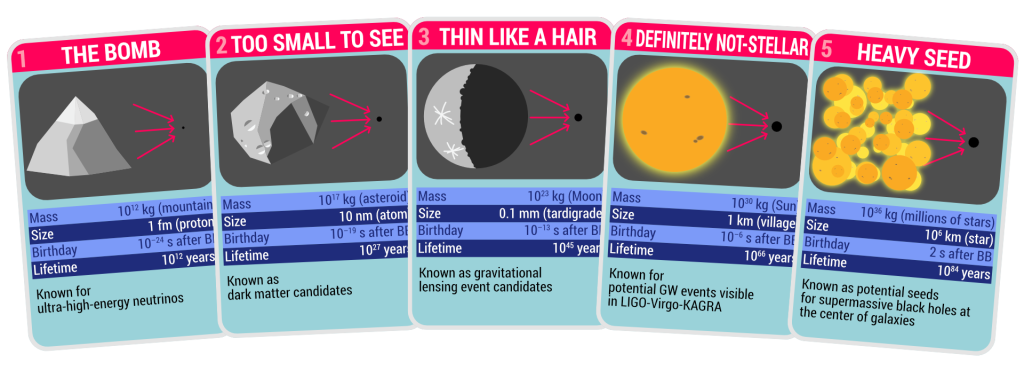
Black hole formation in the primordial universe
If you are unfamiliar with the Big Bang model, you may want to read our spotlight about the Big Bang. Briefly, the Big Bang model says that the universe in its primordial stages was very small, dense, and hot, filled with relativistic particles like photons and neutrinos. It was also almost completely homogeneous and isotropic. The word almost is crucial here, as we have measured the relics of primordial density fluctuations in Cosmic Microwave Background (CMB) observations. Galaxies and all structures we see are also seeded by such primordial density fluctuations.
The leading explanation for the origin of primordial density fluctuations is cosmic inflation, a phase of accelerated expansion that stretched tiny quantum vacuum fluctuations to macroscopic scales. The vital prediction of inflation is a universe filled with random density fluctuations. Why is this relevant to PBHs? Well, in a random field, there is a non-zero chance that somewhere there is a large fluctuation. If it’s large enough, it will collapse into a black hole.
This is a very unlikely event, as you may have guessed. But, if the probability is not negligibly small, the universe’s expansion will take care of compensating for the “unlikeliness” of PBH formation–a plasma of relativistic particles dilutes faster than a gas of PBHs. The catch is that for PBH formation not to be negligibly small, we need a large root mean square for primordial fluctuations, much larger than the one we measured in the fluctuations of the CMB. Nevertheless, inflationary processes yielding such amplification are well understood.
Collapse of pocket universes
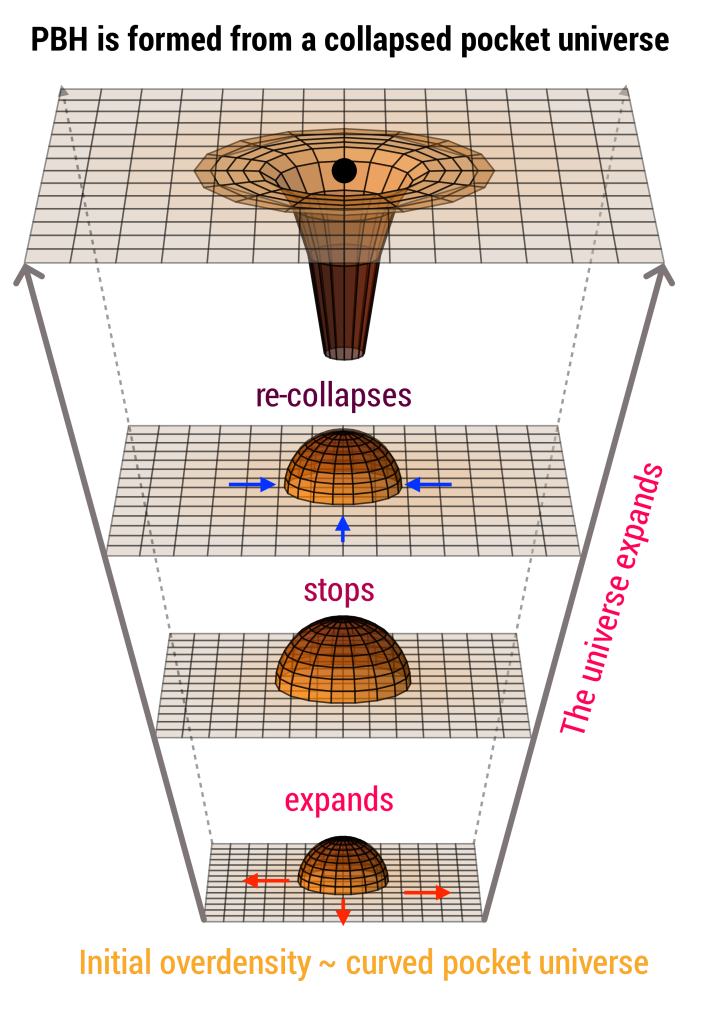
Saying that a big fluctuation collapses is not enough. What actually happens is more interesting.
You may picture an expanding universe as a sequence of expanding “grids” in time. With each time step, the grid expands. But the grid may also be curved. For example, it could be a flat sheet (like our current universe), a sphere, or a kind of hyperboloid. In particular, the sphere’s positive curvature acts as an additional gravitational pull on the grid, potentially leading to re-collapse.
In this geometric picture, an overdense region in the primordial plasma can be interpreted as a cut sphere stacked atop our flat sheet. General Relativity then tells us that we can treat each region independently; we can think of our overdensity as a pocket universe. If massive enough, the pocket universe first expands and then collapses under its own curvature, leaving a black hole behind. The re-collapse occurs exactly when the causal radius of the Universe, called the Hubble radius, equals the overdensity’s radius. All the mass contained within that pocket Universe will, at re-collapse, become a PBH. This provides a clear correspondence between PBH mass and the time of collapse.
In principle, by this mechanism, PBHs could have any mass depending on the properties of primordial density fluctuations. Some see this as a drawback, but I see it as an opportunity to link unexplained observations to cosmic inflation, which would be inaccessible otherwise. Find evidence of a single PBH, and you will revolutionise our understanding of the Universe.
The associated Gravitational Wave background
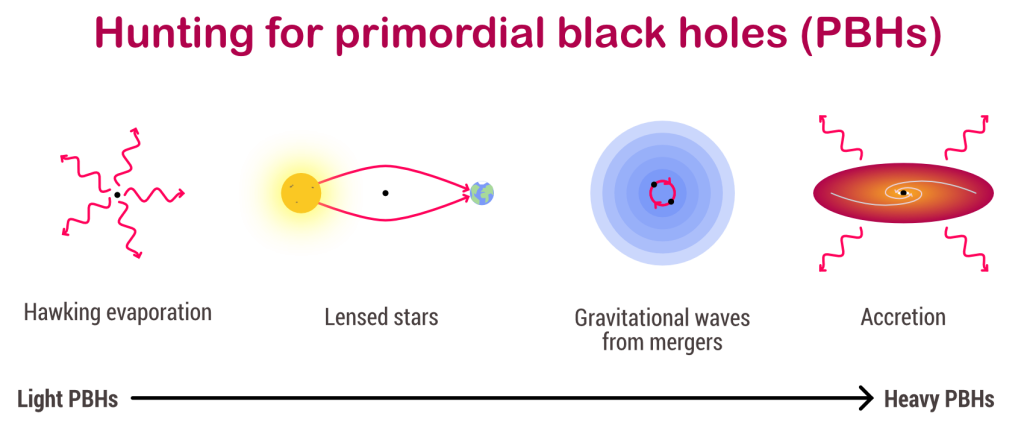
There are many interesting ways to hunt for PBHs, like microlensing of stars, Hawking evaporation, and GWs. The obvious, direct GW signal comes from the merger of nearby PBH binaries. But there is also a relic GW background generated in the primordial universe, around the time of PBH formation. These GW relics are not due to the collapse of pocket universes but rather to the underlying conditions that enable their collapse.
To understand the process, we must come back to the random density field. As explained, only the rarest and largest fluctuations collapse to PBHs. The remaining fluctuations, while not big enough to collapse into PBHs , generate a multitude of sound waves (these are the same sound waves whose imprint we see in the CMB, but on a much smaller scale). It is this storm of sound waves that stirs spacetime, creating ripples – gravitational waves – that permeate the Universe. GW detectors today would see a stochastic signal with a distinct spectrum, nothing like the noise we expect from local disturbances or the stochastic background from distant astrophysical sources. This is what we call a cosmic GW background.
The GW background spectrum will peak at a frequency set by the sound waves, which is determined by the size of the primordial fluctuations. The root-mean-square of primordial fluctuations will determine the peak amplitude of the GW spectrum. But, at the same time, the size and root mean square of the primordial fluctuations also determine the mass and fraction of PBHs. And so a remarkable correspondence between PBH mass and peak GW frequency, and PBH abundance and peak GW amplitude appears. As we argued, the root mean square of primordial fluctuations must be large for PBHs to be important. So, the predicted GW background counterpart must be loud.
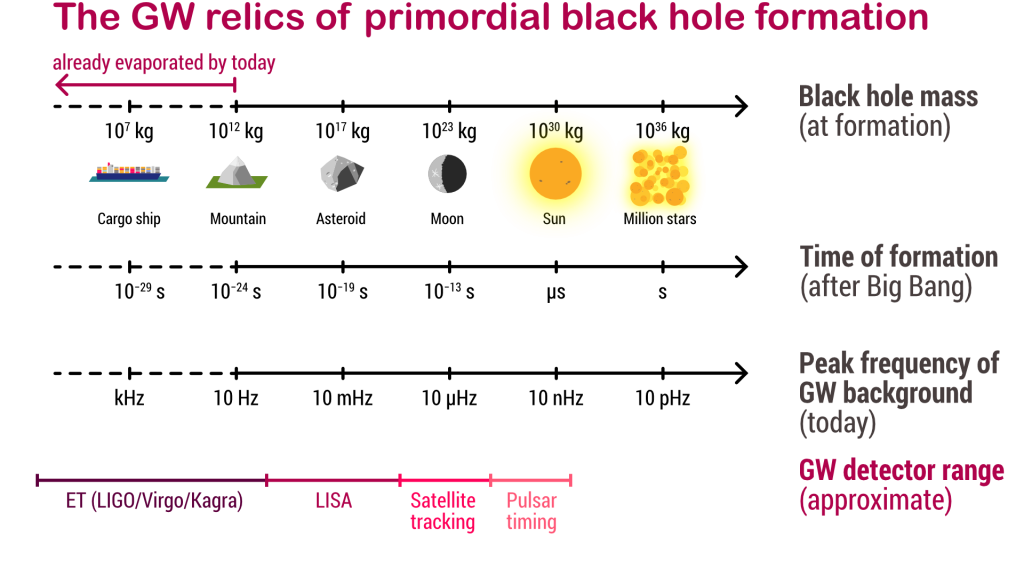
The connection between GW background observations and PBHs is fascinating, as shown in the following figure. LISA in the mHz regime will directly probe PBHs as dark matter. PTAs and Astrometry probe the presence of solar- and planet-mass PBHs. LIGO/VIRGO/KAGRA and ET might find traces of PBHs that have already evaporated. Even in the worst-case scenario, we surely will obtain new constraints on the primordial universe and cosmic inflation from previously unexplored epochs.
Final remarks
Based on our current knowledge, it is plausible that PBHs play an important role in the Universe, perhaps as the dark matter and/or seeds of supermassive black holes. If so, we should find the corresponding gravitational-wave background. If we don’t, then PBHs do not constitute a significant fraction of dark matter. As we enter the era of multi-messenger cosmology, we will test PBHs using a wide range of complementary observations, including gravitational-wave backgrounds, direct and continuous gravitational-wave searches, microlensing, and more. [See Fig. 4 for an illustration of the hunt for PBHs.] In two decades, we should be able to cover gravitational wave frequencies from nHz to MHz and beyond.
If primordial black holes exist, the violent primordial conditions that gave birth to them also generated a background of gravitational waves that still permeates the Universe today. As new detectors come online, we may finally hear those echoes from the dawn of cosmic time. It won’t be too long before we know whether primordial black holes constitute a significant component of our Universe.
Further Information
Colophon
is an Emmy Noether group leader at Leibniz University Hannover and a recipient of the Heinz-Maier-Leibnitz Prize. He specialises in early-universe cosmology, gravitational waves and theories of gravity.
Citation
Cite this article as:
Guillem Domenech, “Is our Universe stuffed with Black Holes?” in: Einstein Online Band 17 (2026), 17-1002
Further Articles
 Observation of Gravitational Waves from a Binary Black Hole Merger
 Cosmic Sound: Curvature and the cosmic background radiation
 How the Event Horizon Telescope observes black holes
 Black holes & Co. / Elementary tour part 2: Black holes
 A tale of two big bangs
 Relativity and the Quantum / Elementary Tour part 4: Loop quantum gravity